What the rat forgot
Eight chapters of buildup reduce, in the end, to a binary question. The animal slept. The laser fired on every replay event that the decoder labelled Room A; it stayed off for everything else. Twenty-four hours later, with the rewards removed, the animal was placed back into Room A and, separately, into Room B. Where did it look for food?
The probe
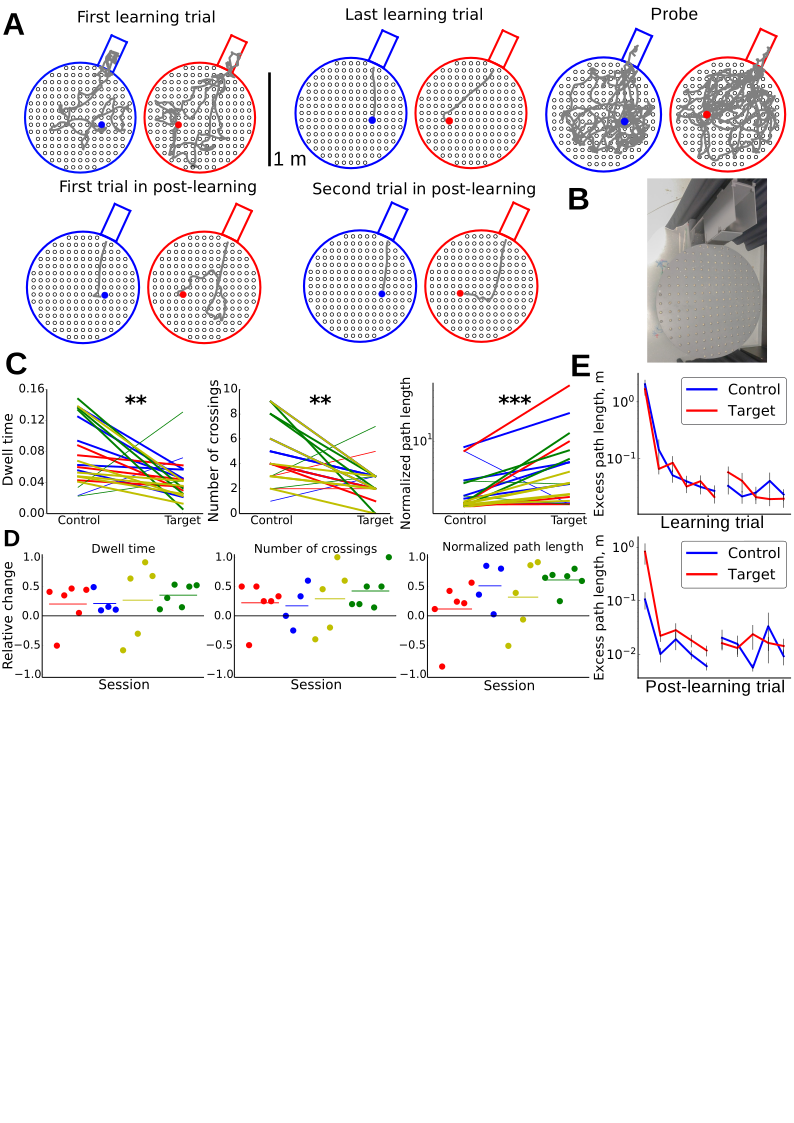
A probe trial in the cheeseboard paradigm is sixty seconds long. The wells are empty. The animal is set down at the edge of the board and allowed to search. Three behavioural read-outs measure how well it remembers the food locations: the dwell time at the previously rewarded wells, the number of crossings of those wells, and the path length — the total distance walked. A rat that remembers heads roughly straight to the correct wells and lingers; a rat that has forgotten wanders, drops in on incorrect wells, and clocks more total distance.
The simulation below shows a stylised side-by-side probe. Both panels run for sixty seconds of simulated time, played back at four times speed. The rewarded wells are highlighted in each room. Same animal, same training, same neurons; the only intervention is the laser trigger that fired on Room A replays during the night.
Both animals received identical training in their respective rooms. Both completed the same number of learning trials. The only difference is what happened to their replay events during the 4-hour rest in between — on the left, replays of this room were selectively disrupted; on the right, the laser stayed off. Press Run to watch a 60-second probe trial in each room, with rewards now removed.
The pattern is consistent across animals. Time at correct wells is reduced in the target room. Crossings drop. Path length grows. The control-room performance — the rat’s own memory of the other configuration, formed on the same day, consolidated in the same sleep, retrieved using the same neurons — is indistinguishable from a session with no intervention at all. The deficit is selective.
The map underneath
A behavioural deficit raises an obvious next question: what is happening to the cellular representation? Was the place code itself destroyed by the disruption, or is the code intact and the access to it impaired? The two possibilities have very different implications for what closed-loop replay disruption actually does, and for whether the targeted memory is gone or merely temporarily out of reach.
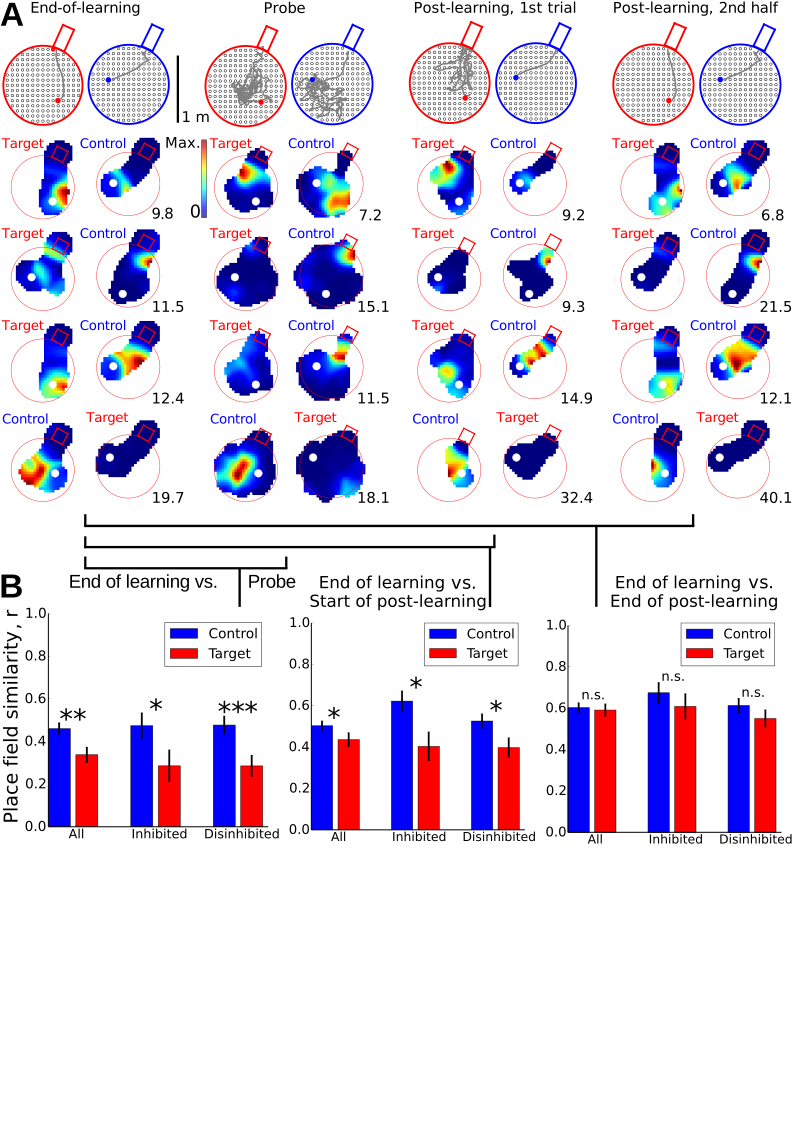
The measurement that separates these hypotheses is place-field similarity, or PFS. For each cell, you compute its rate map in two epochs and correlate the two maps; a high correlation means the cell’s place field is in the same location and has the same shape across both epochs, a low correlation means it has shifted or destabilised. Average PFS across the recorded population gives a single number for how stable the representation is between any two periods.
The arc below tracks PFS across the experiment. The pre-task baseline measures the intrinsic stability of the place code in each room. The probe is recorded right after the disrupted sleep. Trial 1 is the first re-exposure to the food-well configuration. Trials 6 and 10 sit deep into the recovery. Hover the chart to read each value.
Hover the chart to read values. Replay redraws the arc.
The target-room PFS drops sharply in the probe and trial 1, and recovers to control-room levels by trial 6. This is the answer. The cellular map was not destroyed. It was destabilised — rendered less coherent, harder to read out cleanly — and that destabilisation, not a permanent erasure, is what produced the behavioural deficit. With new exposure to the room, the same cells re-encode the same place fields, and behaviour follows.
What this means
Two things, taken together, define what the experiment found.
Replay matters for recent memory. Selectively disrupting the replay events that referenced one of two simultaneously-learned environments produced a measurable, selective behavioural deficit in that environment’s probe. Both memories had the same encoding, the same time to consolidate, and the same retrieval mechanism. Only the targeted one degraded.
Replay disruption is not erasure. The cellular map of the disrupted environment recovers within a handful of trials. The closed-loop intervention does not destroy the underlying representation; it interferes with the consolidation step that normally would have stabilised the memory after a single learning session. With re-exposure, the same cells re-encode the same fields and the deficit closes.
That is the central claim of the paper, and it is a more careful claim than “replay is necessary for memory.” The earlier blanket-SWR-disruption studies could not have distinguished this from outright erasure, because every memory was disrupted equally and the re-learning profile would not have isolated which memory was the target. The two-room paradigm, the content-specific decoder, and the recovery profile in the PFS arc together make a very specific claim: replay shapes how recent experience becomes retrievable knowledge, and the absence of replay leaves the memory in a kind of transient unreadable state that further experience can repair.
That last point — that the memory is recoverable — is the part that turns this from a basic-science finding into something with implications for therapeutics, prosthetics, and human memory more generally. The next, and final, chapter is about those implications.